Catrina's Garden

A place for gardeners, foodies and garden inspired artists.

All about Basil

Basil…either you love it or you hate it. Maybe if you hate it it’s because you haven’t really had “good” basil. Dried Herbs old1 Is this what the basil you are used to looks like? There is nothing wrong with dried basil, but if you use it this is what it should look like. Dried Herbs Fresh1Dried herbs don’t have a really long shelf life. Depending on where you store them the will only last about a year. When they have lost their bright green color and no longer have a nice aroma you may as well toss them. Old herbs won’t hurt you but as my dad says “they taste like grass”.


So where should they be stored? Well, dark and cool is best but you really don’t need to keep them in the refrigerator; just not right over the stove. Keep them in a container that is tightly sealed.

Freshly dried herbs are great but if you have never had fresh herbs you are really missing out. Here in Wisconsin, Basil is an annual herb. Basil and other annual herbs should be treated like fresh flowers. Many annual herbs can be stored for a short time in the frig.Fresh Basil1 If you put a piece of paper towel in the bag with them it will absorb moisture and keep them fresh longer. some people keep basil in the frig, but I wouldn’t recommend it. Basil will turn black if it gets too cold or will get dark spots. It’s still okay to eat if it’s not mushy; just not pretty.  Instead harvest it fresh (ideal) for each use or if you purchased it cut then put it in a cup or vase, just like it is a cut flower. It really can be quite beautiful. If you see it all the time, you will be more likely to use it too.

So, you could grow your own; we’ll talk about that next time.  However, you can buy it too. “It’s so expensive” you say. Well, yes, often times in the grocery store it is. Look for it at farmer’s markets and/or your local Asian market. If you find it for a good price get a lot and preserve it.

Thai basil flower1By the way, you can eat the flowers too. Try them, they are good; and also pretty on a salad.

Next click here to learn how to Grow Great Basil.

For the History of Basil click here.


Root Cellar Carrots – Maple Glaze Recipe

Purple Haze carrots and sugar snack carrots I got a little carried away with the carrots this year. We had quite a few different colors. The gold and white varieties are pretty but I really like the dark red and purple ones. The have way more beta carotene than a standard carrot, and are simply beautiful on the plate. Having unusual colored veges is always a great way to get people talking at the pot luck too. These are Purple Haze and Sugar Snack Carrots at the peak of the season.

Holly with carrots1Carrots are such a fun crop for kids to grow too. They just love all the different colors and are more likely to actually eat them if they saw them being produced.

This time of year all of the best and most beautiful veges are long gone. The sweet crisp, thin skinned carrots don’t store very well, but I still had a bucket of Danvers and Bolero carrots which I grow for eating later in the winter. I do have a root cellar, so that helps. It’s best to store them at a temp from the high 30’s to the low 40’s. The trick is to keep them moist enough so that they don’t shrivel up but not so moist that they rot. I use a mix of half sand half garden soil. Whatever you do don’t wash them before you store them, you can remove the leaves, but don’t cut off the tops and when you bury them in the sand, try to arrange them so they don’t touch. These storage varieties have more fiber and starch but bolero has a thinner core than Danvers, and both of them are great cooked; much better than anything you would get in the grocery store this time of year.

So I dug the last of them out and this is what I made with them. The maple syrup and orange makes up for these storage carrots being a little less sweet. We cook our own maple syrup here in Wisconsin; not for production or sale…yet. We just do small batches for ourselves and for gifts.

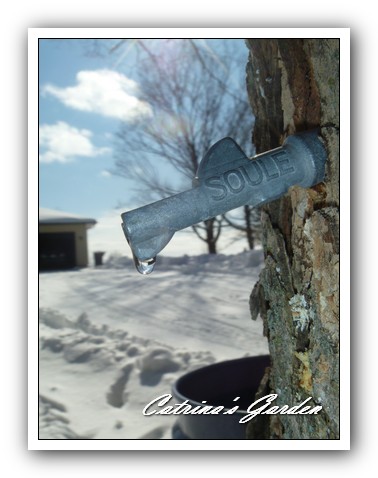
1Maple Syrup Sap Dripping 5You could use store bought syrup but nothing beats pure 100% maple syrup. Check back for more on “sugarin” in spring.

So here’s the recipe:

Maple Glazed Carrots

½ cup pure maple syrup

1 cinnamon stick

¾ cup orange juice – You can use a little lemon or lime juice in place of the orange if you like it a little more tart

2 oranges or one small can of mandarin oranges

¼ cup water

1 ½ tbsp. cornstarch

1# sliced or diced carrots

1-2 tbsp. butter (you can use olive oil if you are worried about it)

½ cup Parsley (you can use fresh mint too if you have some. Pineapple or other fruit flavored mints are especially good.)

Salt and Pepper to taste

Maple Glazed Carrots - CopyFirst make the maple the glaze: Place maple syrup, cinnamon stick, orange juice and oranges in pan and simmer lightly. Break up the oranges with the spatula. In a cup, stir together water and cornstarch until smooth. Add the cornstarch slurry slowly into the maple mixture, and continue to simmer and stir over low heat until it is thickened. This may take a while; be patient and don’t turn up the heat too high. Remove the cinnamon stick and any skins and pith from the oranges.

Sauté the carrots in the butter or oil until they are starting to get soft; how soft is really up to you, I know people who insist that the carrots aren’t done unless they are really soft, I tend to like them a little firmer.

Add the maple glaze, salt, pepper and herbs. If you use fresh oranges you can zest them before you peel them and then add the zest at the end for extra bright citrus flavor. This makes 4 to 6 servings.

Enjoy a taste of summer from your root cellar.

Is it an Herb or a Spice?

My herbs are looking pretty good, even though it is very early in the season. Here on the border of zone 3 and 4, I moved some of them to the in-ground beds of my greenhouse so that I was able to use them all winter. After doing this for a few years, I learned that it is a good idea to dig them up earlier so that they can get a good root system developed before the cold weather sets in. This way they will live through the winter…even Rosemary.  Soon they will be moving back out to the herb garden.

Garlic Chives allium tuberosum

Garlic Chives allium tuberosum

We (meaning most cooks that I know) often use the words herb and spice as though they were the same animal. Herbs and spices both come from plants. Herbs and spices are both used to flavor food and add that all important aroma. Both are best when used fresh, but they can be saved by drying or in some cases freezing. However, don’t be fooled into thinking that this will keep them forever.

Powdered Spice (2)

Powdered Spice (2)

So, what’s the difference? Herbs usually, but not always, come from the leaves of herbaceous plants. What’s an herbaceous plant you say? Well, it is a plant that is non woody. This is why I say usually, but now always. I think rosemary and thyme among others can be a bit woody. Herbs usually are used in larger amounts than spices. There are some that say that an “herb” is any “useful” plant. The “use” doesn’t have to be for cooking. It can be used for medicinal purposes, for dying, or in any other useful way. In the middle ages they threw them on the floor to cover the stink in the house. The term “herb” is also used by botanists to mean simply that the plant dies down, and may not even be referring to its use. Most herbs originated from temperate climates like England, Italy, France, and yes; the “new world”. Some examples of herbs include: parsley, sage, rosemary and thyme (thanks S&G), but also basil (my favorite), oregano, marjoram, chives and mint, to name a few.

Thyme

Thyme

Spices on the other hand come from parts of the plant other than its leaves, like the bark, roots, seeds, fruits or flowers. To confuse you a bit, they can come from “herbaceous” or woody plants. The flavor of spices is, as a general rule, a lot stronger, so again, usually but not always, less is used. Most spices come from warm tropical places. Sorry dear, you can’t plant a Catrinas-Herb-Garden-159x300cinnamon tree in your yard here in Wisconsin. There are a few spices that actually help food keep longer as well as adding flavor. I suppose this could be helpful in a warm tropical climate. Examples of spices include: Cinnamon (this is the bark of the cinnamon or should I say Cassia tree-more on this in a future post), nutmeg, cumin, coriander and dill (all from seeds), Vanilla (from the underdeveloped fruit of an orchid), Ginger (a root), and Cloves (from a flower bud).


Some plants are both herbs and spices. The leaves of Coriandrum sativum are the source of cilantro (herb) while coriander (spice) is from the plant’s seeds. Dill is another example. The seeds are a spice while dill weed is an herb derived from the plant’s stems and leaves. In case you were wondering, salt is not an herb or a spice, it is a mineral.

Whole Spice (2)

Whole Spice (2)

Heartsease

pansy-very-dark-redI had heard this term before moving “up north”. But when I got here one of the first friends that I made used this as her “computer name” so I became more accustomed to the name.

This diminutive little pansy known to all as Jonny-jump-up, love in idleness or herb trinity is call heartsease because it is said to mend a broken heart. Shakespeare makes reference to this in A Midsummer Night’s dream. Oberon dispatches Puck to gather the “little western flower that maidens call Love-in-idleness”. Cupid’s arrow falls upon the plant that is “before milk-white, now purple with love’s wound”. Oberon and Puck are able to control the fate of other characters in the play by using heartsease; “on sleeping eyelids laid, will make or man or woman madly dote upon the next live creature that it sees.”

Pansy Jolly JokerThe scientific name Viola tricolor tells us it is from the family violaceae (the violets) and tricolor because it is usually purple yellow and white. Violas are a close relative, but all of our wonderful longer lived pansies were developed from this plant. Pansy comes from the French – Pensee meaning thought or remembrance. Here is why in Shakespeare’s Hamlet Ophelia says “There’s pansies, that’s for thoughts”.

Some say all pansies can be called heartsease, but viola tricolor is the original one.  Pansies are among our edible flowers and are sometimes candied on fancy deserts, frozen into ice-cubes or thrown into salads.  Purple-and-white-pansy

They have been used forever as a mild treatment for pertussis and bronchitis due to their expectorant properties; cystitis, polyuria and dysuria due to their diuretic properties, and they are also a mild laxative, so don’t eat too many of these little cuties on your salad. They also contain salicylic acid, salicylates and rutin, so they have anti-inflammatory properties and can be used to treat gout and rheumatoid arthritis.

Used as a compress or ointment they treat eczema, psoriasis and acne. Although they are usually used in combination with other plants by herbalists, this is truly an amazing little plant.

So, what is the secret of growing Heartsease? There is none! Just ignore it and it will “jump up”. The fancier pansies will self-sow too, and will sometimes, but not always come true to seed. Of course you can find them at any garden center in early spring, but if you want a certain variety you may want to consider growing your own. If you do, keep these tips in mind; first start with fresh seed. Start early, I usually try to get mine going as soon after the holidays as I can.  They take 6-8 weeks to be large enough and can be set out quite early, as they are frost tolerant.  As with any seed starting use a soilless mix and keep them moist with bottom watering. But this difference with pansies; they should be kept cool (like about 65 degrees). No bottom heat for these darlings.  Another difference from many flower seeds is that they need darkness to germinate, so cover them with a little soil and throw the daily news on top of them until they sprout, then bring them into the light. Lastly, my favorite tip, grow them through spring as most people do, but then when summer comes and they start getting leggy and not so beautiful, don’t pull them out. Instead cut them waaaaaay back. They will all but disappear under your other flowers, but then in fall they will jump-up again for 3 more months of cuteness.

Walter Savage Landor says it all in this little poem.

Heartsease

There is a flower I wish to wear,

But not until first worn by you,

Heartsease of all earth’s flowers most rare;

Bring it; and bring enough for two.


Some may call this plant a “lawn weed”. But how can you not love a cute little plant that requires no care and heals a broken heart?

Catrina

Click here to read about Pasque Flower for Easter

Try this link to read about Early Spring flowers

If you would like a few more pics of Early Spring Bulbs click here

Promise of Spring – Start Now!

Layering Bulbs – Small garden or no garden – No Problem!

Tulips and daffodils are what most people think of when they talk about spring bulbs, but there are so many more to choose from.  Most bulbs require very little root space so they can be planted quite densely and thus are perfect for those that have small gardens. They also don’t take up a lot of space in the garden once they are growing because most die back after blooming and have tall straight stems. Because flowers are generally pretty large and showy compared to the amount of foliage, you get a lot of bang for your garden space buck. In a one to two square foot hole you can get a patch that will flower from early spring well into summer.

First step; pick your bulbs. Usually but not always bigger bulbs will have bigger flowers and little bulbs; you guessed it smaller flowers. The bigger ones generally, but not always bloom later. So, even if you don’t know the exact bloom time for your bulbs you can be pretty safe planting the bigger ones on the bottom and decreasing the size as you move up in your layers. Do your research on bloom time if you want to be sure that you will always have something in bloom.  There are many different bulbs that could be included but the main categories are:

• Lilies and Alliums (for summer bloom)
• Narcissi and Tulips (for spring bloom)
• Muscari, Scilla, Iris reticulata, Crocus and other early spring bulbs
These are the “classic” bulbs that are used but please; check out your catalogs for some more unusual offerings!

You don’t have to use all of these layers; just two layers would also be fine. Layering also works great over a larger area. You can mix and match your bulbs however you like…be creative. If you use 2 different types of tulips (for example) in a layer, you may lengthen your bloom time a little bit. Do use your “design sense” however. If you use too many different things in one area things can look a little bit chaotic.  Oriental-lily-Loreto

How many bulbs should you buy?  You have to think about if you care about next year’s show, or what you will see in 3 or 4 years. How often do you want to dig it up and redo it? Plant more to get a great show the first year, and less if you want to take the lazy way out and not have to dig them up so soon do to overcrowding. Here are some approximate numbers.  In a 2 square foot hole you could fit, about 5 lilies, 7-12 daffodils, tulips or alliums (or any combination of them) and 20-30 small bulbs. The size of the bulbs is also important. You can fit fewer big top size bulbs than small offsets…duh.
What colors should you use? Well, what colors do you like? Work with the colors of other things in your garden. Too many colors can cause the eye to jump around. Usually you don’t have to worry about this however because your bulbs will be blooming at different times.
All of your plants don’t have to be bulbs.  It is fine to use a ground cover such as a quick-growing annual or low growing perennial in the top layer.  Some ideas of things to use here are parsley, alyssum, creeping sedums, creeping veronicas.  These ground covers serve 3 purposes; they add beauty to your planting in-between the flowering of the bulbs, they “mulch” the soil, conserving moisture and preventing weeds, and they can help to hide the foliage of the bulbs when they are done.
Layering bulbs is similar to making lasagna.  Layers of drainage material, bulbs, soil and ground covers or mulch are used instead of sauce and noodles.

The first step is to find a bare spot in the garden.  Check out your perennials in the summer and mark the spot as it can be difficult to remember in fall when the perennials are finished.  Since you will be planting densely the spot really does have to be empty of other plants to begin with.
Another benefit of planting all of your bulbs in one spot is that it will be easy to find them in fall when you want to divide them.  Scilla-mischtschenkoana
Here is your step by step “How To”:
• Dig a deep hole at least 12″ but 14″ is better and at least 16-18″ wide (remember you can use a larger area). The hole does not have to be perfectly round.  An irregular sized hole will give you a more natural appearance.
• Remove the soil and mix it with lots of good compost and add any organic or other fertilizer that you choose to use. Move the soil mixture into a bucket.
• Place some drainage material like coarse sand in the bottom of the hole, 1-3 inches is good depending on how sandy or clay-like your soil is.
• Next fill in about 2-3″ of the soil mixture.
• Now you can start to plant. Large bulbs go first. Cover with about 2″ of your soil mix.White-Tulip
• Next plant mid-sized bulbs. You try to fit them in between the bulbs below but don’t worry, emerging shoots of the lower layer bulbs just bend around anything they hit sitting over their heads and keep on growing.  Again cover with 2″ of your soil mix.
• Then plant the smallest bulbs that are also the earliest blooming. Finally cover with the last of your soil mix. It should be about 2 more inches and the ground should be level.
• After the blooms have faded, be sure to let the foliage die back naturally because this is how bulbs build up their strength for next year. It is okay to remove the flower stalks when they are finished to keep the garden looking tidy. You can also remove old foliage when it starts to yellow. It is green foliage that is nourishing the bulb for next year. It’s okay to bend it down a little if you don’t like the way that it looks.
• Water a little more often in the first weeks after you plant your bulbs to help them form their roots.
Please be careful when removing foliage from bulbs or picking cut flowers.  Many bulbs especially daffodils, tulips and hyacinths can cause severe contact dermatitis in susceptible individuals. Wear gloves and be very careful not to drip the sap from the stems on your skin.  Many workers in the bulb industry will tell you that “lily itch” is no fun.

Don’t worry; certain bulbs may be planted a little deeper than they would if you just planted them by themselves. The stuff in the hole will provide better protection winter heaving and at worst they will bloom a little later than your neighbor’s.

Daffodil-tazetta-Canary-BirdMany people also use bulbs for layering in containers.  This makes a beautiful display for your porch or patio.  Here are some things to remember about planting bulbs in containers.
• The bulbs can touch each other but should not touch the sides of the container.
• In Wisconsin even hardy bulbs will probably not survive the winter in containers.  You will have to either say good-bye to them or plant them in the ground.
• Bulbs like tulips and daffodils need a period of cold to bloom so either put them in the refrigerator or you can try putting the whole pot in a very cold but not freezing garage or basement.
• This is a perfect way to use bulbs that are not hardy in our area like elephant ears, cannas, callas, caladiums, and tubers like dahlias.  Once the display is finished you can put the entire pot in a cool dark place in your basement and bring it out in spring.  This works best if you have a sunny place indoors where you can bring them out and get them going before the season starts.
• Bulbs in containers will need extra fertilizer.
• Your contained bulbs will eventually outgrow your pot; some quicker than others, and you will have to replant.
• Planting in a pot is a great idea for certain bulbs that are sometimes eaten by rodents like crocus, and tulips.
• Make sure your pots have drainage holes (very important) and add additional drainage material in the bottom of the pot.
• It’s not a good idea to leave valuable clay or ceramic pots outside.  Freeze thaw cycles can crack them or cause them to flake.  Cement or plastic pots are fine outside over the winter.

Happy planting!

Catrina


Page 45 of 45

Powered by WordPress & Theme by Anders Norén